How much does tree removal cost in North Carolina?
Tree removal in North Carolina runs about $150 to $400 for a small tree, $400 to $800 at 30 to 60 feet, $700 to $1,300 at 60 to 80 feet, and $1,000 to $2,000 or more past 80 feet, based on published state and Charlotte-area rates. Most homeowners land near $700 per tree.
Here is what sets the number, and why the same tree can price two different ways depending on whether a crew climbs it or a machine lays it down.
Tree removal prices by size
| Tree size | Published North Carolina range |
|---|---|
| Under 30 feet | $150 to $400 |
| 30 to 60 feet | $400 to $800 |
| 60 to 80 feet | $700 to $1,300 |
| Over 80 feet | $1,000 to $2,000 and up |
| Already on the ground | $85 to $300 |
| Stump grinding, added | about $2 to $3.50 per inch |
Per-foot math backs the tiers: national guides price removal around $10 to $14 per foot of height. Note the stump. Nearly every quote leaves it in the ground as a low-cut stump, and grinding or pulling it is its own line. Our guide on stump grinding vs stump removal covers that decision.
What moves the price inside the range
Species is the quiet one. Loblolly pine grows straight and drops predictably, so it prices low for its height. Oaks, hickories and sweetgum carry dense wood and wide crowns, and published oak ranges run $900 to $2,000 against $200 to $1,500 for pine.
Condition cuts both ways. A dead tree is brittle and unsafe to climb, which adds risk money to a climbing quote. Access matters, and a tree a machine can reach prices better than one behind a pool. Disposal is a real line too, with hauling published at $75 to $250 per truck trip; keeping the wood for firewood trims the bill. Storm and emergency calls run 20 to 50 percent over standard rates, while winter scheduling saves 20 to 30 percent. And count helps: taking several trees in one mobilization earns 10 to 25 percent off each.
Machine removal vs a climbing crew
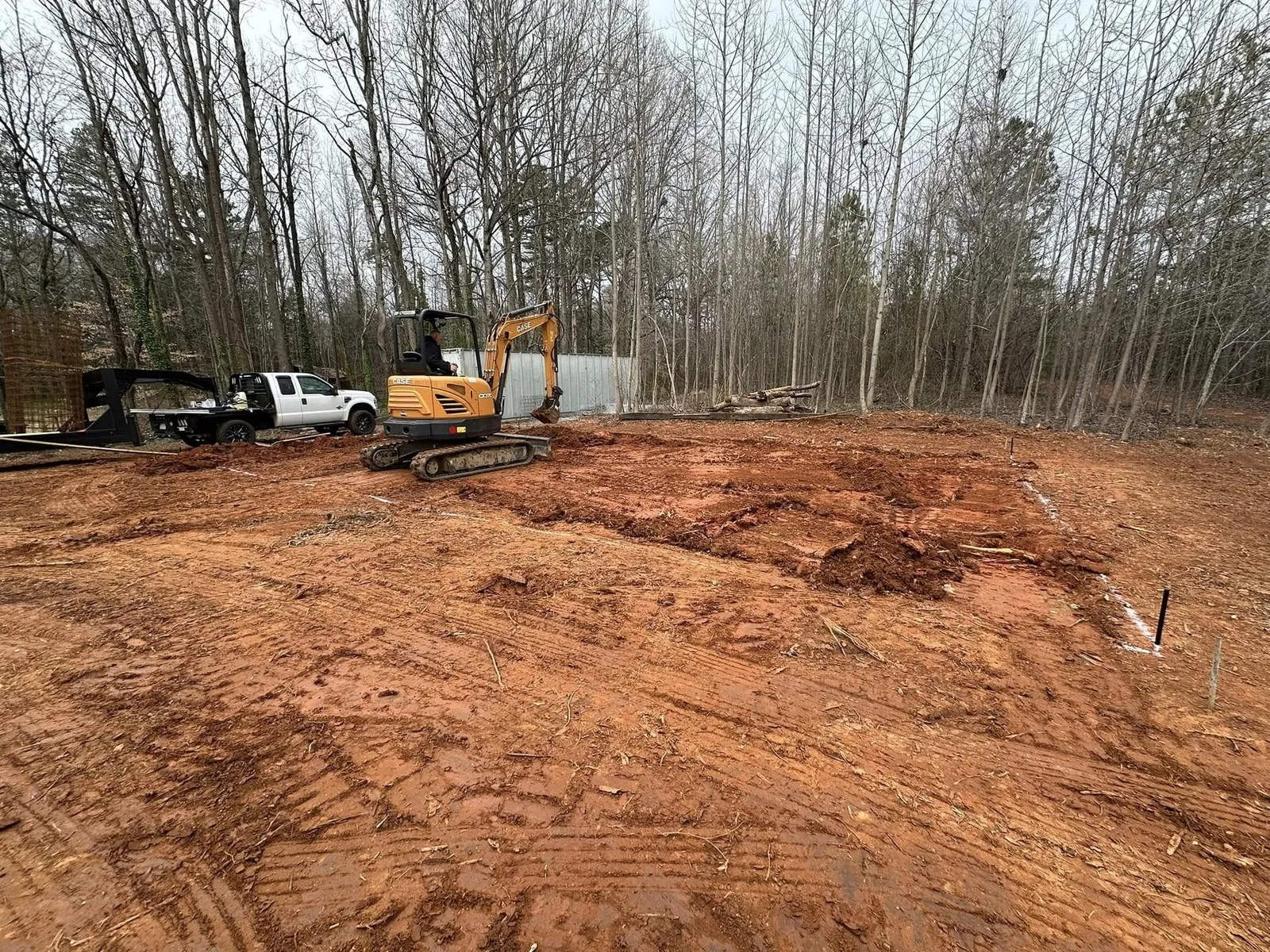
We do tree removal around Shelby with machines. An excavator or skid steer works the tree from the base on open ground, the whole stem comes down in one controlled drop, and the wood gets cut and loaded on grapple trucks. Nobody leaves the ground. That is the whole reason open-ground tree work prices well: one drop instead of a piece-by-piece dismantle, and every extra tree is marginal machine time.
Climbing crews exist for the other situation. A tree hanging over a house, threaded through power lines, or standing where nothing can fall needs ropes, rigging and sections roped down one at a time. That work runs about 50 percent higher near structures in published figures, and it should. Tree work is one of the most dangerous trades in the country, with a fatality rate around 110 per 100,000 workers, roughly 30 times the all-industry average. A machine with the operator in the cab takes most of that risk off the table, but only where there is room to use it.
So the honest sort is simple. Open ground, dead pines, leaners, lot trees, whole stands: machine job, our job. Over the roof or in the lines: climbing crew, and we say so at the estimate. Power lines add a legal step either way, because North Carolina law bars equipment within 10 feet of a high-voltage line and requires notifying the utility about 48 hours before work near one. Call Duke Energy before anyone touches a line-side tree.
The trees coming down around Shelby right now
Beetle-killed pine is the steady call. The state’s forest health reporting has Ips engraver beetles active across the Piedmont, hitting pines stressed by drought, and this summer’s severe drought has extension offices urging landowners to watch their pines closely. A beetle-hit pine can go from green to brown in weeks. Sawdust at the base, fading yellow-green needles and peeling bark are the tells, and the standing dead tree it leaves sheds limbs long before it falls.
Storms stack on top of that. Hurricane Helene damaged an estimated 822,000 acres of North Carolina timberland in September 2024, including 42,587 acres in Rutherford County and 28,925 in Lincoln County, most of it blowdown and broken tops. Piedmont ice storms do the slower version of the same thing, because pines hold their needles through winter, load up with ice and snap out their tops. Extension guidance says a tree with more than half its canopy gone, a broken leader, major trunk damage or a new lean should come down on your schedule, not the wind’s.
Multiple trees and whole lots
Past a handful of trees, stop pricing per tree. Lightly wooded ground clears for a published $733 to $2,333 per acre and heavily wooded ground $3,395 to $6,155, with North Carolina wooded acres commonly quoted at $2,500 to $6,000 and up. That is machine economics: the mulcher, excavator and grapple trucks are already there, and the per-tree number collapses. What land clearing costs per acre in North Carolina breaks that whole job down, and our debris removal trucks handle the wood either way.
Get a number on your trees
Count the trees, note the dead ones, and call (704) 600-8146. We look at the lean, the ground and the access, tell you plainly if any of it is climbing-crew work, and price the rest on the spot. Estimates are free. LDS Solutions is veteran owned and removes trees across Shelby, Kings Mountain, Boiling Springs, Gastonia, Lincolnton, Forest City and the rest of our 25 mile circle.