
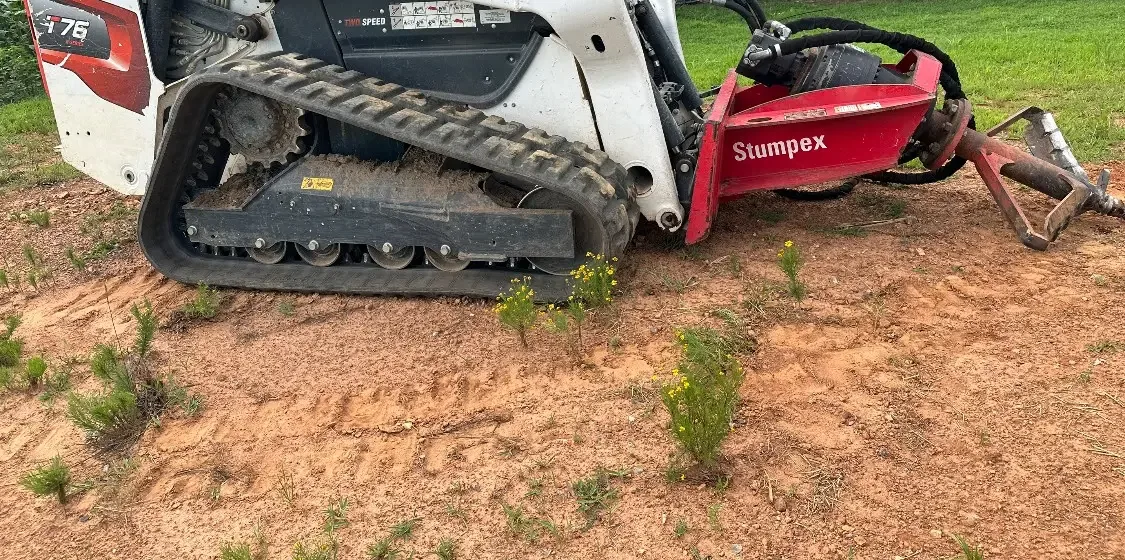
How much does stump grinding cost in North Carolina?
HomeGuide’s 2026 data puts stump grinding at $120 to $400 for the first stump. That is $2 to $6 per inch of trunk diameter. Angi prices a standard job at $250. Most guides list a trip minimum near $100. A 24 inch stump lands in the middle of that.
Those are national ranges, not a quote. Diameter, stump count, access and what the spot has to do next set the real number. We handle our stump grinding and root removal work around Shelby, and every price starts with a free on-site look.
What does it cost to grind one stump?
One stump runs $120 to $400 in HomeGuide’s December 2025 update. Each stump after it drops to $30 to $60. Extra-large stumps run $300 to $800 each. Angi puts a standard job at $250, with large-diameter stumps reaching $1,600. Lawn Love’s band is tighter at $120 to $210.
| Published rate | Range |
|---|---|
| First stump | $120-$400 |
| Each additional stump | $30-$60 |
| Per inch of diameter | $2-$6 |
| Per hour | $100-$200 |
| Per day | $800-$1,600 |
| Minimum service fee | $80-$160 |
| Extra-large stump | $300-$800 |
Those rates are HomeGuide’s 2026 figures.
The other guides sit close to it. Angi and Lawn Love both run $2 to $5 per diameter inch with a $100 minimum. Angi puts extra stumps at $40 to $75 and Lawn Love at $40 to $70. LawnStarter prices grinding at $131 to $438 per stump.
Those numbers cover the stump only. Taking the tree down is priced separately, and our North Carolina tree removal cost guide covers it.
How much does it cost to grind a 24 inch stump?
A 24 inch stump runs $50 to $150 in HomeGuide’s size chart. Angi’s chart says $148 to $220, with the trip minimum built in. Lawn Love lists $48 to $135 and LawnStarter $49 to $128. A small stump still bills at the minimum charge.
| Stump diameter | HomeGuide | Lawn Love |
|---|---|---|
| Up to 12 inches | $30-$70 | $26-$62 |
| 24 inches | $50-$150 | $48-$135 |
| 36 inches | $70-$220 | $71-$200 |
| 48 inches | $100-$290 | $98-$265 |
| 60 inches | $120-$360 | $120-$330 |
| 72 inches | $150-$430 | $147-$395 |
Both charts are 2026 data, the first from HomeGuide and the second from Lawn Love. HomeGuide’s footnote puts minimum service fees at $80 to $160.
Measure across the widest part of the stump at ground level. HomeGuide says contractors measure the base of the trunk, not just the cut surface. The flare at the bottom is what the price runs on.
Is it cheaper to grind a stump or pull it out?
Grinding is cheaper on nearly every job. LawnStarter’s method table puts grinding at $131 to $438 per stump against $190 to $630 for manual removal. HomeGuide prices digging a stump out at $80 to $190. In the same data a backhoe carries a $150 to $350 minimum.
Grinding cuts the stump into chips below grade and leaves the roots in the dirt. Removal takes the stump and the root ball out whole, and the hole gets backfilled and packed. Root work bills by the hour when it runs long. LawnStarter puts that at $100 to $185 per hour and HomeGuide at $75 to $150. We break the two jobs down in our side-by-side on grinding versus full removal.
What goes over the spot decides which one you buy. North Carolina’s residential code (R506.2) covers this. Ground under a slab or foundation has to be free of vegetation, topsoil and foreign material, and the fill compacted. Buried wood rots and the ground drops years later. If a pad or a level yard is going in there, plan on the roots coming out. Here is how we cut and level a building pad.
What moves a stump grinding price up or down?
Diameter sets the base price and everything else adjusts it. HomeGuide lists tree type, size, stump count, grinding depth, access, terrain and debris removal as the drivers. Angi adds location, stump health and time of year. Both charge more for hardwood, which takes longer and needs a bigger machine.
- Count. The first stump carries the trip. HomeGuide drops each one after it to $30 to $60.
- Access. Angi has pros billing $50 per hour extra, or a flat fee up to $200, on a hard job.
- Depth. Standard grinding goes 4 to 6 inches below grade. Going to about 18 inches for the whole stump and its big roots costs more.
- Season. Angi puts winter as the cheapest time for this work, with savings as high as 20 percent.
- Haul-off. Cleanup and disposal is an add-on in every guide.
Rock is the local variable. Toward the foothills, stone can sit a foot or two down, and a wheel that finds it slows right down.
What happens to the grindings and the roots?
The chips either go back in the hole or leave on a truck. A grinder turns the stump into a pile of wood chips that partly fills the hole it came from. We rake them in as fill, or load them out with grapple trucks. Haul-off is priced apart from the grinding in every guide.
HomeGuide puts cleanup and disposal at an extra $2 to $4 per inch of the stump’s diameter. Angi lists $50 to $200 to haul the waste away. LawnStarter charges $1.5 to $4 per diameter inch to take the stump and its roots off the property.
Chips are not topsoil. NC State Extension’s Franklin County office writes that fresh wood chips tie up nitrogen as they decompose. It also says to keep wood chips away from plants until they break down. If you want grass on that spot this season, the chips have to come out.
Burning a pile of stumps is regulated. Open burning of land clearing debris falls under 15A NCAC 02D .1903 in North Carolina. That rule sets hours and setbacks, so state burn rules apply before anything is lit. Our grapple trucks haul the wood off instead.
Roots left in the ground can sprout. The USDA Forest Service silvics record for sweetgum describes regeneration from root sprouts off suppressed root buds. It reports 40 or more stems on the root system of one parent tree. The same series says older loblolly pine will not produce basal sprouts or root sprouts once the stem is cut.
What does Piedmont red clay do to a stump job?
Cleveland County sits on Piedmont red clay, and that changes the dig more than the grind. Cecil series subsoils run 35 to 70 percent clay and take in water at about half an inch per hour. Rock can sit a foot or two down toward the foothills. Both show up in root work.
Clay holds a root ball tight, and wet clay holds it tighter. Shelby averages 47.89 inches of rain a year at the NCEI gauge, with about 15 days carrying an inch or more. A wet week pushes machine work back until the ground firms up.
Storm stumps are their own job. Hurricane Helene hit on September 27, 2024, and the NC Forest Service appraisal that October put timber damage at 822,000 acres statewide. Rutherford County accounted for 42,587 acres of that. A blown-over tree leaves a tipped root ball full of dirt instead of a flat stump. The tree comes down before the stump comes out, and we do that tree work from the ground with machines.
What does the job look like start to finish?
We look at the stump first, then set a date after the estimate. On the day, the machine gets to the stump. The wheel takes the wood down below grade, and the chips get raked in or loaded out. If the roots have to come out, an excavator or a root grapple does that part.
Two rules run the access side. NC 811 gets three full working days of notice before any digging. The locate marks stay good for 28 calendar days under G.S. 87-122. No machine works within 10 feet of a high voltage line, and the utility gets 48 hours of notice.
Time on site is short for most yards. HomeGuide puts a single stump at 15 minutes to 3 hours, set by size, wood hardness and where it sits.
If you have one stump or a yard full of them around Shelby, we will come look and price it. The estimate is free, and the number you get is for your stump instead of a national average. Call (704) 600-8146 or send us the details on your job.