
How much does it cost to hire an excavator with an operator in North Carolina?
Published cost data puts an excavator with an operator at about $100 to $300 per hour. That is HomeGuide’s range for an operator who brings a mini excavator, backhoe or skid steer. HomeAdvisor’s range, operator included, is $100 to $250. Most operators bill a one-day minimum, and a real number needs an on-site look.
Neither source is specific to North Carolina, and neither is our quote. Operated machine time is part of our dirt work around Shelby. You can hire a skid steer, excavator or dozer with our operator by the hour or the day.
What do published sources say an excavator with an operator costs?
HomeGuide and HomeAdvisor both start at $100 an hour, operator included. HomeGuide tops out at $300 per hour and HomeAdvisor at $250. HomeAdvisor puts a compact skid steer or backhoe at about $100 per hour. A full-size excavator, it says, costs roughly 50 percent more per hour.
The table pulls from HomeGuide’s excavation and forestry mulching guides and from HomeAdvisor’s excavation guide. None of these figures is specific to North Carolina.
| Machine and billing | Published range | Source |
|---|---|---|
| Mini excavator, backhoe or skid steer with operator, per hour | $100-$300 | HomeGuide |
| Excavation equipment with operator, per hour | $100-$250 | HomeAdvisor |
| Compact skid steer or backhoe with operator, per hour | About $100 | HomeAdvisor |
| Full-size excavator with operator, per hour | About 50 percent more than compact | HomeAdvisor |
| Bulldozer or excavator with operator, per day | $1,200-$2,500 | HomeGuide |
| Operator only, no machine, per hour | $50-$150 | HomeGuide |
| Minimum project fee | $500-$800 | HomeGuide |
Roughly 50 percent more than HomeAdvisor’s $100 compact rate works out to about $150 per hour. HomeGuide’s own advice is that an excavation contractor must visit the site in person to create an accurate estimate. We work the same way: we look at the job, then price it.
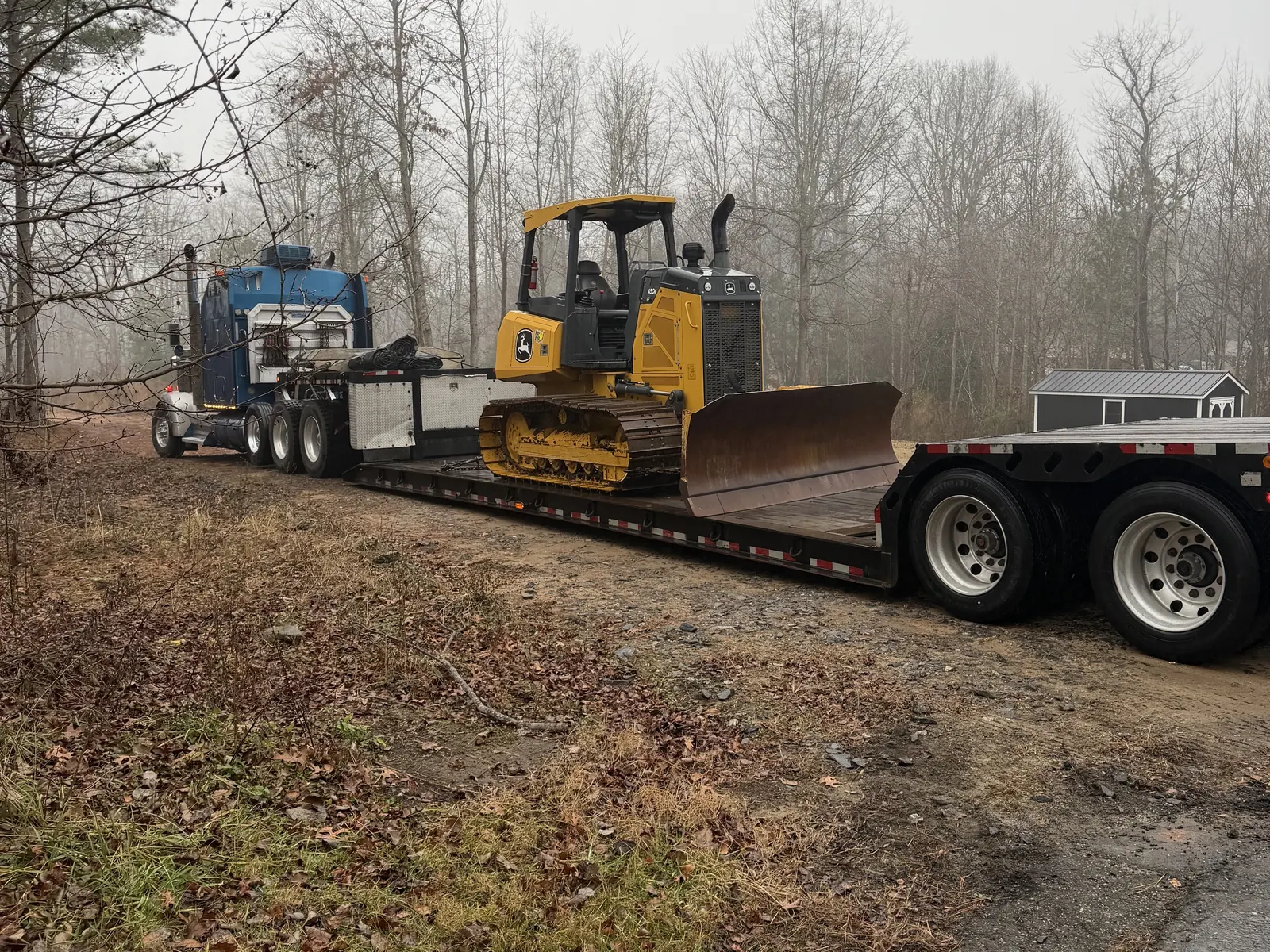
Size changes what an hour buys. We run excavators from a mini up to a 27 ton machine. A mini fits a fenced yard or a narrow trench line, and a big excavator moves more dirt per bucket. Footings, trenching and site prep are on our excavation page.
How much does a skid steer with an operator cost per hour?
Published cost data puts a skid steer with an operator at about $100 to $300 per hour. HomeAdvisor prices a compact skid steer or backhoe at $100 per hour, operator included. HomeGuide lists $100 to $300 per hour for grading companies with a bobcat or skid steer loader. They typically have a one-day minimum, HomeGuide adds.
Our tracked skid steers carry root grapples for brush and logs. A skid steer also runs our stump grinder attachment. It fits through gaps a dozer cannot, and it spreads and grades what is already on site.
A driveway job adds stone to the bill. The supplier delivers it, and we spread and compact it. Stone prices per ton are in our gravel driveway cost guide.
How much does a dozer with an operator cost?
HomeGuide’s forestry mulching guide puts a bulldozer or excavator with an operator at $1,200 to $2,500 per day. It notes these machines remove roots below ground. HomeGuide gives it as a day rate for machine and operator together. A real number still needs an on-site look.
A dozer pushes. Ours carries a root rake for pulling stumps and roots out of cleared ground. It also cuts a rough grade for a house pad, a shop or a long driveway.
Clearing a wooded lot is a different job with its own math. Our land clearing cost guide covers the per-acre prices.
If the goal is grinding brush and small trees in place, a forestry mulcher may fit better than a dozer. Our forestry mulching cost guide covers that work.
Is it cheaper to pay by the hour, the day or the whole job?
It depends on how well the work can be measured up front. HomeGuide says most excavation contractors charge by the cubic yard or the total project. Some charge by the hour for small projects. Hourly suits short or open-ended work, and a bid suits a job with a clear scope.
HomeGuide says most operators charge a minimum of one day or eight hours. At its $100 to $300 hourly range, that minimum comes to $800 to $2,400. HomeAdvisor says even a tiny trench can trigger a base charge.
Many excavation contractors also set minimum project fees of $500 to $800, according to HomeGuide. If your list is short, add the small jobs you have been putting off. A second trench or a pad cut can fit inside a day you already pay for.
A bid moves the risk of slow ground to the contractor. HomeGuide prices excavation by volume at $2.50 to $15.00 per cubic yard. HomeAdvisor says general contractors often quote a flat project rate instead of charging by the hour. Many build weather risk into their bids, it adds.
What moves the price of an excavator with an operator?
The bill is the rate times the hours, so anything that adds hours adds cost. Machine size, operator skill, access and soil all change the hours. HomeAdvisor says a full-size excavator costs roughly 50 percent more per hour. It adds that the larger bucket can cut overall labor time.
- Operator skill. A skilled operator digs and grades with fewer passes. A lower hourly rate that takes more hours can cost more in the end.
- Access. HomeGuide says costs rise when the site has tight spaces requiring smaller or specialized equipment. A fenced back yard may call for a mini excavator or a skid steer.
- Moving the machine. We haul our machines on our own lowboy trailer. HomeGuide’s forestry mulching guide says some mulching companies charge a $150 to $300 mobilization fee for setup. It also says they add transportation fees for moving equipment, based on their service areas.
- One trip for several jobs. HomeAdvisor suggests bundling grading, trenching and clearing so the crew and equipment only mobilize once.
How do red clay and wet weather change the hours around Shelby?
Wet red clay slows a machine, and slow work adds hours to an hourly bill. HomeGuide prices heavy or wet soil at $10 to $15 per cubic yard to dig. Light soil runs $2.50 to $6 in the same table. HomeAdvisor says clay-heavy soil can add $200 to $1,200 or more.
Most of the ground we dig around Shelby is red clay. The USDA’s official description of Cecil soil places it on the Piedmont uplands. In its typical profile, red clay starts about 8 inches down. The USDA calls that clay firm, sticky and plastic.
NOAA’s climate normals give Shelby 47.89 inches of rain in a normal year. NC State Extension tells farmers to avoid field operations when the soil is wet. Drier soils, it says, have higher strength and greater resistance to compaction.
HomeAdvisor says crews work more slowly on a lot with heavy clay, and charge for it. We wait for wet clay to dry before we cut or grade it. A few dry days can save hours of slow work in mud.
How does hiring an excavator with an operator work?
It starts with a free on-site estimate. We come look at the job, then price it and set a date. Before any digging, NC 811 gets at least three full working days of notice under G.S. 87-122. On the day, we haul the machine in on our own lowboy trailer.
Bigger jobs carry one more rule. Under G.S. 113A-57, disturbing more than one acre on a tract needs an approved erosion and sedimentation control plan. The statute calls for filing it 30 or more days before work starts. The rule follows the ground disturbed, however the machine time is billed.
Hiring a machine with our operator works best with a written list and the spots marked before we arrive. A clear list keeps the hours on the work. When clearing is part of the day, our grapple trucks haul the brush off.
Pricing a few hours or a few days of machine work? Call (704) 600-8146 or ask for a free on-site estimate. LDS Solutions is veteran owned and fully insured. We are based in Shelby and work about 25 miles out across Cleveland, Gaston, Lincoln and Rutherford counties.