
How much does rip rap cost in North Carolina?
Published cost data puts rip rap stone at about $20 to $60 per ton, per HomeGuide. Angi lists $20 to $110 per ton. Installed, HomeGuide puts riprap at $4 to $10 per square foot for materials and delivery. Angi prices shoreline projects at $70 to $400 per linear foot. A real number needs an on-site look.
Those are market figures, not our quote. We set rip rap at pipe outlets, in ditches and on washed out banks. It is part of our drainage and erosion control work around Shelby. The stone comes from a quarry or supplier, and they deliver it. Our excavators place it over a filter.
What does rip rap cost per ton and installed?
Rip rap stone runs about $20 to $250 per ton across three national cost guides. Bigger stone sits at the top of that span. HomeGuide puts installation at $4 to $10 per square foot for materials and delivery. Angi’s shoreline figures run $70 to $400 per linear foot.
HomeGuide, Angi and HomeAdvisor all publish national numbers, none specific to North Carolina.
| What is priced | Published range | Source |
|---|---|---|
| Rip rap stone, per ton | $20-$60 | HomeGuide |
| Rip rap stone with delivery, per ton | $25-$70 | HomeGuide |
| Riprap, per ton | $20-$110 | Angi |
| Riprap, per ton | $35-$250 | HomeAdvisor |
| Installed, materials and delivery, per square foot | $4-$10 | HomeGuide |
| Shoreline job, materials and labor, per linear foot | $70-$400 | Angi |
| Shoreline job, what most homeowners spend | $10,000-$30,000 | Angi |
| Labor to lay riprap, per hour | $50-$100 | HomeAdvisor |
Angi’s $20,000 national average is a shoreline number. A rock apron at a driveway pipe is a far smaller job.
What moves the price of a rip rap job?
Stone size, tonnage, access and slope move most rip rap prices. Angi says costs are driven by the type of stone, site accessibility and slope steepness. HomeGuide says its per ton price depends on rock size and location. The filter under the rock adds its own line on top of the stone.
Bigger stone costs more. HomeAdvisor prices small riprap at the low end and pieces two feet or larger at the high end. Delivery adds to the stone. HomeGuide’s range goes from $20 to $60 a ton for stone alone to $25 to $70 delivered.
Tonnage comes from area and thickness. HomeGuide says one ton covers 20 to 90 square feet, depending on stone size. The state erosion manual sets the layer at 1.5 times the largest stone, never under 6 inches. With 12 inch stone, that means at least 18 inches of rock.
The filter is a separate cost. Angi puts underlayment fabric at $45 for a small 40-foot roll to over $3,050 for a heavy-duty 300-foot roll. A gravel filter is more stone, in layers at least 6 inches thick.
Access and slope set the machine time. Angi says steep slopes and hard-to-reach spots need specialized equipment and higher labor rates. The state manual says slopes near 1.5:1 may need a special stability analysis.
What size rip rap do you need?
The right size depends on the job, and NCDOT sorts rip rap into four classes. Class A runs 2 to 6 inches and Class B runs 5 to 12 inches. Class 1 runs 5 to 17 inches and Class 2 runs 9 to 23 inches. The state erosion manual uses the same classes and sizes stone by purpose and site.
NCDOT’s 2024 Standard Specifications set these sizes in Table 1042-1, and the state manual reprints that table.
| NCDOT class | Minimum size | Midrange size | Maximum size |
|---|---|---|---|
| Class A | 2 in | 4 in | 6 in |
| Class B | 5 in | 8 in | 12 in |
| Class 1 | 5 in | 10 in | 17 in |
| Class 2 | 9 in | 14 in | 23 in |
The manual prefers graded stone, a mix of sizes, for most uses. It settles into a dense, flexible cover and takes less hand work than uniform stone. The spelling varies too. NCDOT writes rip rap, and the state manual writes riprap.
Where does rip rap go on a property around Shelby?
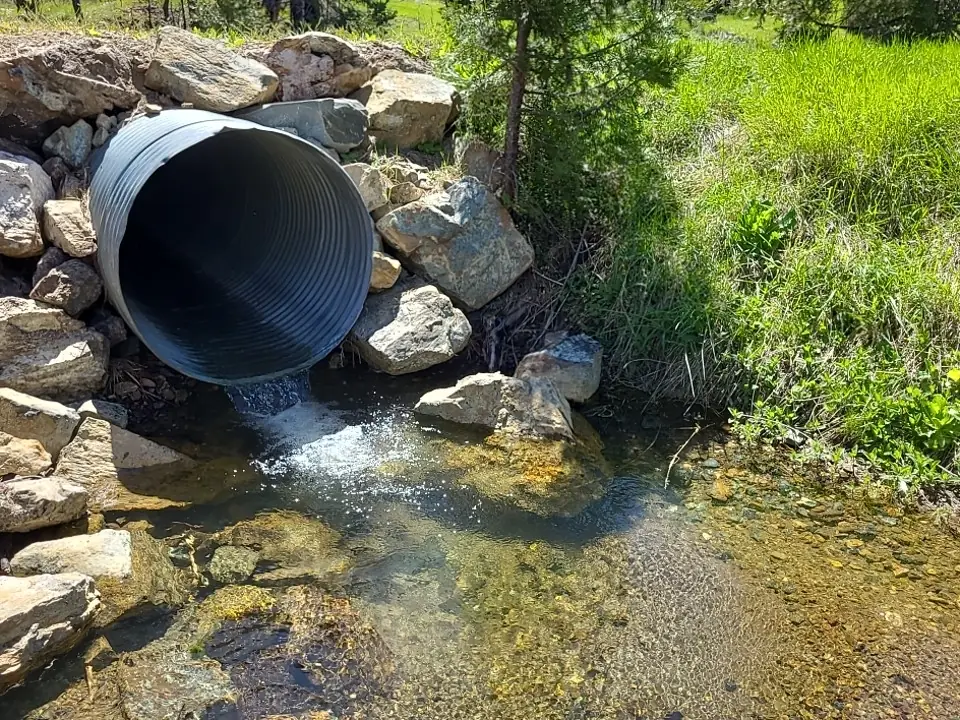
Rip rap goes where moving water meets bare soil. The state erosion manual lists culvert inlets and outlets, channel sides and bottoms, cut and fill slopes, streambanks and shorelines. Around Shelby, that means pipe outlets, ditches, washed out slopes, and pond or creek banks.
At a culvert, the outlet stone goes in before or with the pipe. The manual wants it there before the first runoff. NCDOT also uses erosion control stone at ditches, swales and drainage turnouts. Our guide to driveway culvert costs covers the pipe side.
A washed out slope gets rebuilt before any rock goes on. The manual says the soil must be stable on its own first. Rip rap on a slope should not be treated as a retaining wall. For a gravel drive that loses stone every storm, see our post on gravel driveway washout repair.
Pond and creek banks are the last spot, and the manual lists streambanks, streambeds and shorelines. Work on the bed or banks of a creek can need permits.
Why does bare red clay need rock or cover so fast?
State law puts a clock on bare ground. G.S. 113A-57 says slopes left exposed get cover within 21 calendar days of finishing any phase of grading. The law accepts ground cover, devices or structures that restrain erosion. The state manual lists rip rap for cut and fill slopes where conditions keep vegetation from getting established.
Shelby sits in the Piedmont foothills, and Cecil is one of the red clay soils of the Piedmont uplands. In the USDA’s typical Cecil profile, red clay starts about 8 inches down. The agency calls that clay firm, sticky and plastic. On eroded Cecil ground, the surface itself is sandy clay loam or clay loam.
Disturbing more than one acre needs an approved erosion and sedimentation control plan. It goes on file 30 or more days before work starts. Our post on land clearing permits in North Carolina explains that rule.
Do you need a permit to put rip rap in a creek?
Often, yes. NCDEQ says Army Corps 404 permits are required for the discharge of fill material into streams, wetlands and open waters. Federal rules name riprap as one example of a fill discharge. A state 401 water quality certification usually comes with the federal permit. Check with NCDEQ and the Corps before work in a stream.
NCDEQ’s list of work that may need a permit includes any disturbance to a stream’s bed or banks. Intermittent and perennial streams are regulated by the state and typically by the Corps. A stream does not have to show on a map to count.
A ditch dug for drainage is different. NCDEQ says dug ditches, other than a straightened or moved stream, typically fall outside state and Corps rules. Channels that only run in direct response to rain typically do too. The state Division of Water Resources decides where the streams are, so ask before the rock goes in.
How does a rip rap job go?
We look at the site first, then price it and set a date after the estimate. On the day, the ground gets cleared and cut to grade. The filter goes down, and our excavators set the stone. The quarry or supplier delivers the rock, and our part is the machine work.
NC 811 gets called three full working days before we dig. Brush, trees and stumps come out of the subgrade first, as the state manual directs. Then we cut deep enough that the finished rock sits level with the ground around it. Shaping that ground is the same work as our land grading and leveling.
Geotextile edges overlap at least 12 inches, with anchors every 3 feet, per the manual. The stone goes on at full thickness in one pass. The toe is keyed into a stable base, dug about 1.5 times as deep as the layer is thick. Our excavators, from a mini excavator up to a 27 ton machine, reach in and set it.
If a pipe outlet keeps cutting a hole or a bank keeps washing out, call (704) 600-8146. You can also ask for a free on-site estimate. We come look at the water and the ground, then price the job and set a date after the estimate. LDS Solutions is veteran owned and fully insured, based in Shelby. We work about 25 miles out across Cleveland, Gaston, Lincoln and Rutherford counties.