
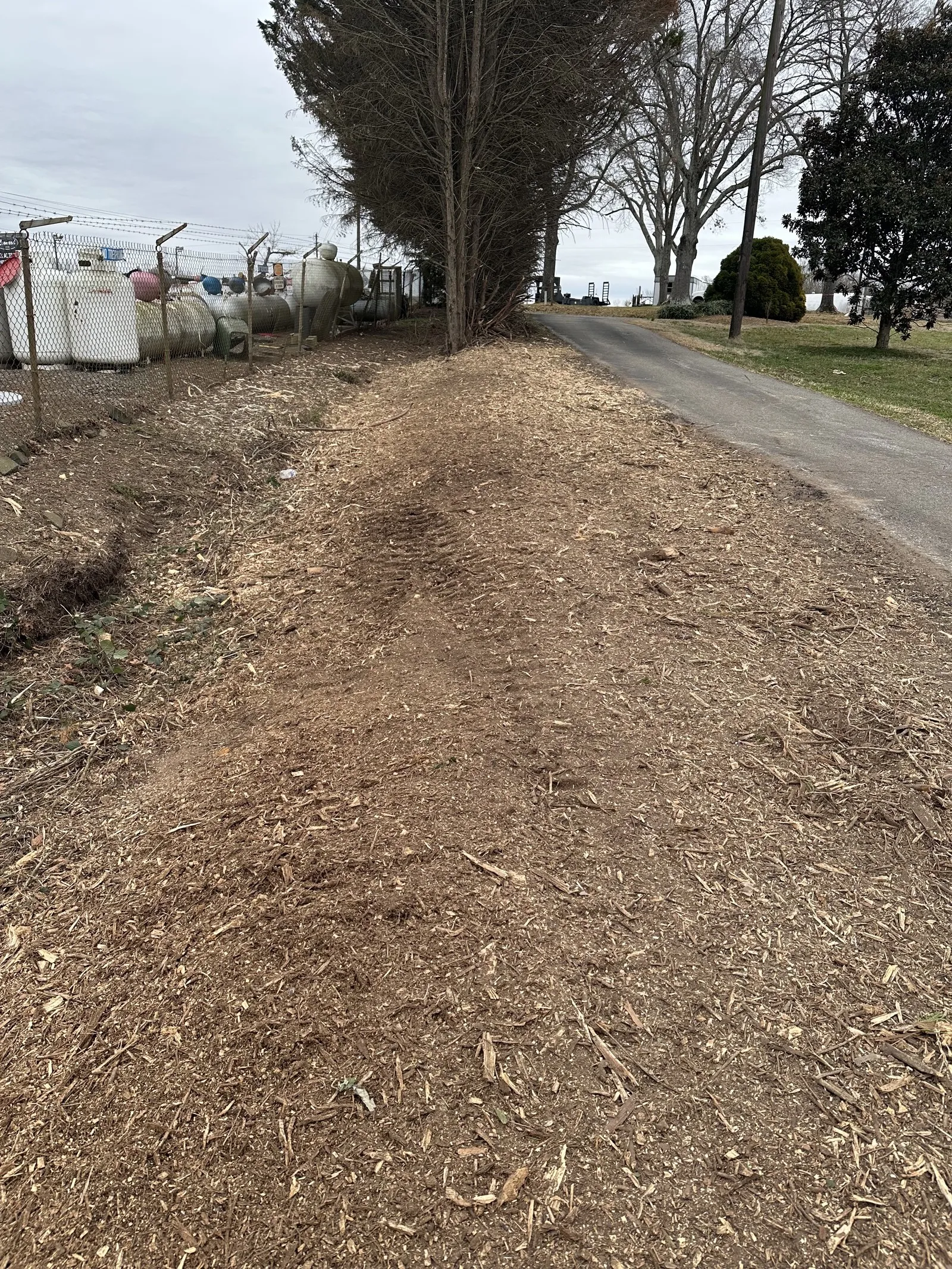
Why does your gravel driveway keep washing out?
A gravel driveway washes out because water is running down it instead of off it. Around Shelby that is a soil problem first: red clay takes in roughly half an inch of rain an hour, and our summer storms drop several times that, so the extra water runs, and the smoothest path downhill is your driveway. The lasting fix is shape and drainage, not another load of rock.
The math working against your driveway
The subsoil under most of Cleveland County is Cecil red clay, with clay contents that run 35 to 70 percent a foot down. Undisturbed, it absorbs only about a half inch of water per hour. Now look at the rain: Shelby’s climate normals run near 48 inches a year, the wettest season is summer, and an ordinary two-year thunderstorm here delivers rain at almost 4 inches per hour for a quarter of an hour. The clay takes its half inch. Everything else moves sideways, gathers speed, and cuts channels through whatever loose gravel it finds.
Winter finishes the job. Shelby averages nearly 90 nights a year below freezing, and almost every one thaws by afternoon. That daily freeze and thaw heaves wet clay and breaks up the packed crust. Then traffic does the rest: wheels flex a wet clay subgrade, pump fines up into the stone, and press two ruts into the lane. The next storm runs down the ruts. Farmers here have fought exactly this water for a century; a hundred years ago Cleveland County was terracing so many hillsides it was called the county of terraces.
More gravel is not the fix
The gravel road manuals put it bluntly: refilling a section that washes out every year is wasted money. The shape is what failed. A healthy gravel drive is an A shape, crowned about a half inch per foot of width, close to a 4 percent side slope, and never more than three quarters of an inch. Rain hits that shape and slides off sideways before it can gather.
What fails is predictable. The crown wears flat, wheel paths compact into shallow troughs, and the A becomes a W. Water that used to shed now collects in the wheel lanes and runs the length of the drive. Our driveway grading work cuts that shape back in: pull the gravel up out of the edges, rebuild the crown, and compact it so it holds.
The stone has to bind
Gravel that stays put is not just rock, it is rock plus fines. Crusher run, sold across this market as ABC stone, carries stone dust and clay-sized fines that pack into a crust and shed water. Clean #57 stone has no fines at all, so it stays loose forever; it is the right stone inside a French drain and around a culvert, and the wrong stone for a washout-prone surface. Around the Charlotte and Gaston market, ABC and crusher run publish at roughly $50 to $63 a ton, higher than the $20 to $40 national guides quote, so plan with local numbers.
On soft clay, fabric earns its keep. A woven geotextile between clay and stone stops the pumping that mixes your base into the mud, and it needs at least 6 inches of stone over it. Rolls publish at $20 to $70 per 100 feet, which is cheap insurance under a rebuilt drive.
Ditches, culverts and water bars
Shedding water off the surface only helps if it has somewhere to go. That means a ditch with fall and an outlet, and a culvert wherever water has to cross under the drive. Small pipes are the classic mistake. NCDOT’s floor for a driveway pipe at a state road is 15 inches and at least 20 feet long, and the road manuals prefer 18 because small culverts plug with leaves and silt. The pipe itself is cheap, around $160 for a 15 inch by 20 foot plastic culvert at North Carolina dealers; the machine work is the real line, with published installs at $1,000 to $3,500. Setting pipe and cutting ditch is driveway culvert installation, and we bed it, set the grade and compact the backfill in lifts.
Long sloped drives get one more tool: water bars or broad dips every hundred feet or so on a moderate grade, angled to kick water into the woods before it can build up speed. State forestry road tables space them tighter as the grade climbs. A drive that used to be one long river becomes a series of short, harmless sheets.
What the repair costs
| Job | Published range |
|---|---|
| Regrade an existing gravel drive | $0.50 to $2.20 per sq ft, or $5 to $10 per linear foot |
| Typical long-drive regrade project | $1,200 to $3,500 |
| ABC / crusher run, local market | about $50 to $63 per ton |
| Culvert installed | $1,000 to $3,500 |
| Geotextile fabric | $20 to $70 per 100 ft roll |
| French drain | $10 to $35 per linear foot |
| Yearly upkeep budget | $100 to $400 |
Those are market figures, not our quote. Driveways vary too much for a phone number, so we look first, and the estimate is free.
The NCDOT part nobody tells you
Most rural roads around Shelby are state-maintained, and the last 20 feet of your driveway sits in NCDOT’s right of way. The useful rules: a single residence normally needs no driveway permit, but the district engineer is the one to call about the connection; your drive is not allowed to send water across the pavement or fill the road ditch; and NCDOT installs a residential driveway pipe at its own expense when the owner buys the pipe and has it delivered. Before any digging on your side of the line, NC 811 marks buried lines free with three full working days of notice. One more line to know: a long new drive cut through cleared land can cross the one-acre erosion-control threshold, and our post on North Carolina land clearing permits covers how that rule works.
Fix it once, then maintain it cheap
A washed-out drive rebuilt with a real crown, bound stone, a ditch and a right-sized culvert stops being an annual emergency. From there the cadence is easy: regrade about once a year, add 2 to 3 inches of stone every 4 or 5 years, and keep the ditch outlets open.
If you are tired of buying the same gravel twice, call (704) 600-8146. We regrade, crown and compact gravel drives, cut ditches and set culverts across Shelby, Kings Mountain, Boiling Springs, Gastonia, Lincolnton, Forest City and the rest of our 25 mile circle. LDS Solutions is veteran owned, and estimates are free.