
How much does a drainage swale cost in North Carolina?
Published cost data puts a drainage swale at about $5 to $15 per linear foot, per HomeGuide and HomeAdvisor. HomeGuide and Angi also price it at about $0.50 to $1 per square foot. These are national figures, not our quote. A real number needs an on-site look at your ground.
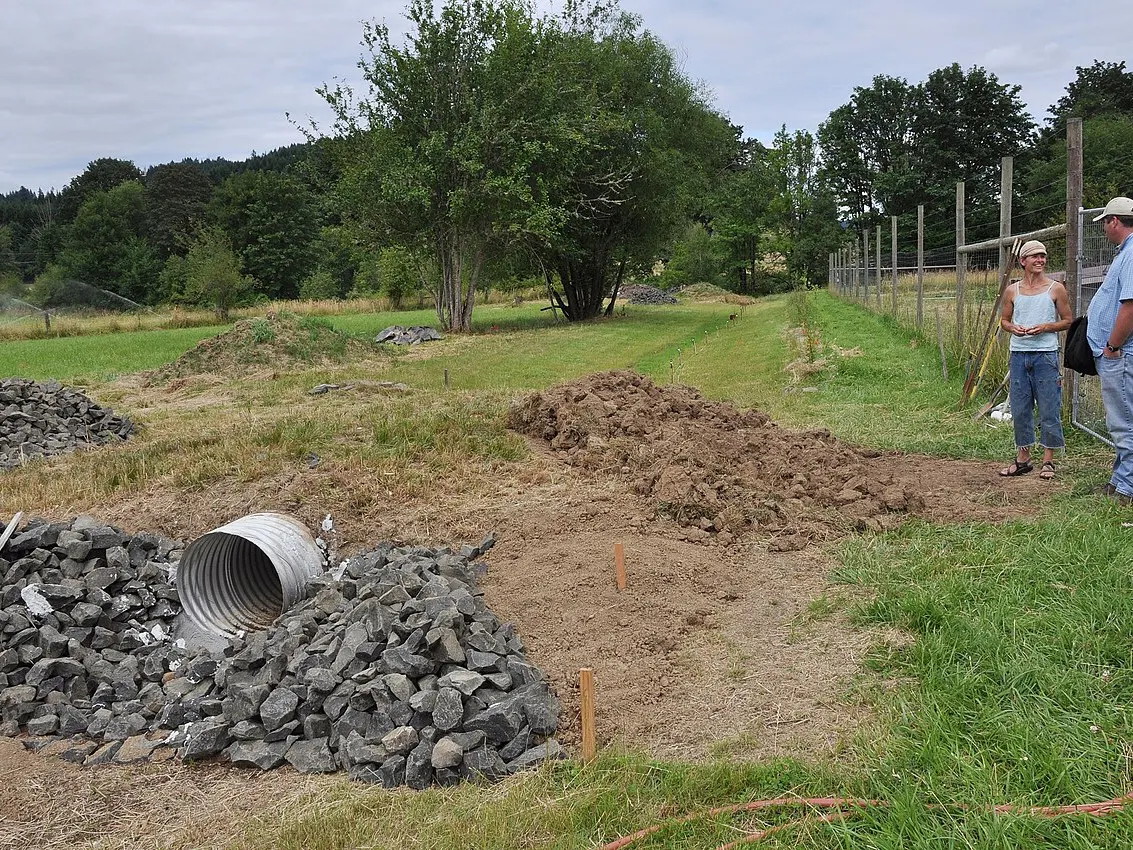
A drainage swale is a shallow channel, graded and lined with grass, that carries yard runoff to a safe outlet. HomeGuide describes it as a sloped channel graded into the lawn. We cut and shape swales as part of our drainage and erosion control work around Shelby.
What does a drainage swale cost per foot?
Published swale prices run about $5 to $15 per linear foot in two national cost guides, HomeGuide and HomeAdvisor. Priced by area, HomeGuide and Angi put a swale at about $0.50 to $1 per square foot. HomeGuide ties the price to the channel’s size and depth, plus the grading it needs.
HomeGuide, HomeAdvisor and Angi publish the national figures in this table. None of them is specific to North Carolina.
| What is priced | Published range | Source |
|---|---|---|
| Drainage swale, per linear foot | $5-$15 | HomeGuide |
| Swale or irrigation ditch, per linear foot | $5-$15 | HomeAdvisor |
| Drainage swale, per square foot | $0.50-$1.00 | HomeGuide |
| Swale installation, per square foot | $0.50-$1 | Angi |
| Drain contractor labor, per hour | $50-$100 | HomeAdvisor |
| Yard reseeding afterward, per square foot | $0.04-$0.18 | HomeGuide |
| Sod afterward, per square foot | $1.00-$2.00 | HomeGuide |
The last two rows are ground cover, a separate job from the dirt work. Seed, straw or sod is yours to put down, or a landscaper’s. HomeGuide’s rows give you a rough budget for that part.
Is a swale cheaper than a French drain?
A drainage swale costs less per foot than a French drain in HomeGuide’s and HomeAdvisor’s figures. HomeGuide lists a swale at $5 to $15 per linear foot and an exterior French drain at $10 to $35. HomeAdvisor puts French drains at $10 to $50 per linear foot, and up to $100 for complex installs.
Angi gives French drain installation $10 to $100 per linear foot, and $500 to $18,000 for a whole system. It calls the swale one of the most affordable drains to install. HomeGuide describes a French drain as a sloped trench filled with gravel and a perforated pipe.
For a whole yard drainage system, HomeAdvisor reports $2,147 to $7,176, with most homeowners spending around $4,634. That figure covers full systems, not one swale. A swale is an open, grassed channel you can see and mow.
What moves the price of a drainage swale?
Length drives most of the price, since published swale prices run per linear foot. The channel’s depth and width matter too, along with the slope. Around Shelby, red clay and tight access add machine time. The outlet may need stone, and the spoil has to go somewhere.
A long, deep swale moves more dirt than a short, shallow one. More dirt means more machine hours.
A swale needs a steady fall toward its outlet. Flat ground may need a deeper cut at the low end to get that fall. Steep ground makes water run fast, and fast water tears at the channel.
HomeAdvisor notes that rocky, clay-heavy, or challenging soil can call for specialized excavation. Around Shelby, the ground is Piedmont red clay.
A tracked skid steer or mini excavator needs a path into the yard. A fence or a tight gate can mean a smaller machine and more hours.
The outlet is where water leaves the swale, and it has to hold up. NCDOT’s standard specifications call for erosion control stone at swales and pipe outlets, among other spots. Our rip rap cost guide covers what that stone costs. A supplier delivers it, and we place it.
Spoil is the dirt that comes out of the channel. It can often be spread and graded on another part of your property. Where it goes is part of the estimate.
What ground and rules shape swale work around Shelby?
Red clay and a few state rules shape swale work around Shelby. State law sets an erosion plan rule above one acre and a 21-day ground cover rule. NC 811 needs notice before any digging. A 1977 state Supreme Court decision also limits how you can change the way water leaves your land.
In the typical Cecil soil profile, red clay starts about 8 inches down, per the USDA. USDA calls that clay firm and sticky. Cecil and Pacolet soils are common in the Piedmont around Shelby. A swale of any depth here gets cut into clay.
G.S. 113A-57 requires an approved erosion and sedimentation control plan before more than one acre is disturbed on a tract. The plan is filed 30 or more days before work starts. One yard swale is far smaller than an acre. On a larger clearing job, confirm the plan question with NCDEQ.
The same statute calls for ground cover on exposed slopes within 21 calendar days of finishing any phase of grading. We shape and compact the channel. The seed and straw that follow are yours to put down, or a landscaper’s.
Before any digging, G.S. 87-122 calls for notice to NC 811 at least three full working days ahead. Buried lines can run right where a swale needs to go.
In 1977, the North Carolina Supreme Court adopted the rule of reasonable use for surface water. You may make reasonable use of your land even if it changes how water flows. Liability comes when the change is unreasonable and causes substantial damage. That is why the outlet is the first thing we look at.
If the swale would empty into a ditch along a state road, check with the NCDOT district office first.
When is a swale the right fix, and when is it a culvert or a regrade?
A swale fits when runoff crosses a yard and there is a safe, lower spot to send it. If the water has to pass under a driveway, it needs a culvert pipe. If the whole yard pools water or tilts toward the house, the fix is often a regrade.
Where a swale meets a driveway, the water has to go under the drive. That is a job for driveway culvert installation. On one property, we excavated and set two 24 inch culvert pipes so the customer could reach the land.
HomeAdvisor says a yard with active pooling or flooding likely needs grading so water flows the right way. It lists grading at $1,025 to $3,300. Our land grading and leveling work reshapes the ground so water runs off on its own.
Many yards need a mix. A regrade can steer water into a swale, and a swale can carry it to a culvert.
How do we build a drainage swale?
We start with where the water comes from and where it can safely go. Then we set the grade and cut the channel with a tracked skid steer or mini excavator. We shape and pack the channel, then armor the outlet with stone where the water leaves.
- We come look at the job for a free on-site estimate, then price it. We set a date after the estimate.
- We trace where the water starts and pick an outlet that can take it.
- We set a steady fall from the top of the swale to the outlet.
- A tracked skid steer or mini excavator cuts the channel. We shape the sides wide and shallow so they can be mowed.
- We pack the channel and its banks so they hold up in a hard rain.
- Stone from a supplier goes where the water leaves the swale.
Seed and straw come next, and they are yours or a landscaper’s. Swales are one part of our drainage and erosion control service, along with ditching and washout repair.
Want a real number for your yard? Call (704) 600-8146 or ask for a free on-site estimate. We come look at the water and the ground, then price the job. LDS Solutions is veteran owned and fully insured.