
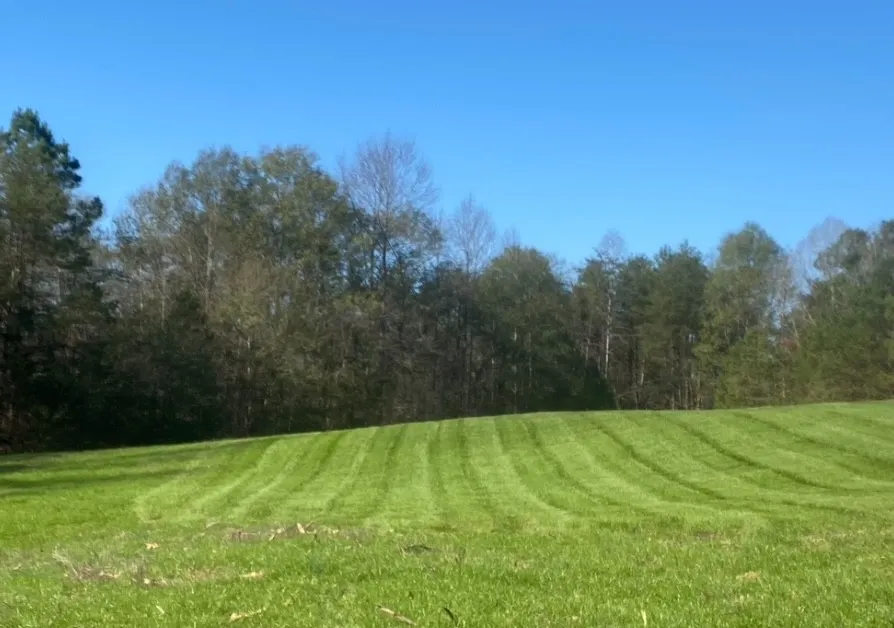
How much does bush hogging cost, and how often should you mow an overgrown field?
Bush hogging costs about $50 to $75 per acre on a maintained field, $75 to $150 on moderate overgrowth, and $150 to $250 or more per acre when the growth is heavy with saplings, based on published market rates. Most crews carry a per-visit minimum, and hourly work runs roughly $85 to $120. The second question matters just as much: mow once or twice a year, or the field stops being a field.
Here is how the pricing works, and the schedule that keeps Piedmont ground open.
What drives the price of bush hogging?
| Factor | Why it moves the number |
|---|---|
| Growth height and thickness | Knee-high grass mows fast. Chest-high briar takes slow passes, often two. |
| Acreage | Per-acre rates drop as acreage climbs. Minimums cover small lots. |
| Terrain | Hills, ditches and wet bottoms slow the machine. Flat pasture is cheapest. |
| Obstacles | Stumps, rock and old fence wire mean slower, wider passes. |
| Years since the last cut | A field mowed last year is a quick job. Four years of growth is not. |
The pattern to notice: waiting costs more than mowing. Every season a field sits, the growth gets taller, thicker and woodier, and the price tier climbs with it.
How fast does a field go backward here?
Fast, and the science on Piedmont old fields backs up what every pasture owner has watched happen. Broomsedge and blackberry move in within two to three seasons. Research from NC Cooperative Extension found unmanaged pastures roughly tripled their broomsedge in three years. Pine seedlings follow, and Piedmont succession studies show pines crowding out the grasses in well under ten years.
Around Shelby that means an idle field is on a clock. Two or three humid summers take it from hayfield to briar patch. A few more take it to young woods, and at that point a rotary cutter cannot fix it anymore.
How often should you mow?
For pasture and open fields in our part of the Southeast, the working rule is one to three cuts per growing season, roughly late April through October.
- Once a year holds a field that is already in decent shape.
- Twice a year keeps it clean and stops blackberry and briar from establishing. A late-spring cut ahead of seedheads plus a late-summer cut is the classic pattern.
- Woody invaders take more: repeated cuts over two or more seasons to run down the root reserves.
Bush hogging on that cadence is cheap insurance compared to reclaiming the field later.
When has a field gone past bush hogging?
Stem size is the line. A rotary cutter handles green saplings up to a few inches thick. Once sweetgum and pine have real trunks, the cutter bounces off and the job changes trades. That is forestry mulching territory: the tracked mulcher grinds the woody growth in place, and after that a yearly mow holds the ground again. Our forestry mulching cost guide prices that job.
If the field also holds years of fallen limbs or dumped debris, a cleanup pass with the grapple comes first. Our debris removal crew handles that in the same visit.
What about town notices for overgrown lots?
North Carolina towns commonly regulate overgrown lots as nuisances, with grass and weed limits in the 12 to 15 inch range in many municipalities and a short window to mow before the town does it and bills the owner. The exact number and process vary town to town, so check the notice or the local code office for your lot. When a notice shows up, we can usually get a lot cut quickly, and you do not need to be there for us to look at it.
Get a number for your field
Rates and cadence get you close. A price takes one look at the field. LDS Solutions runs bush hogging across Shelby, Kings Mountain, Boiling Springs, Gastonia, Lincolnton and the rest of our 25-mile circle, from single lots to full farms. Estimates are free. Call (704) 600-8146 and tell us what grew up on you.